


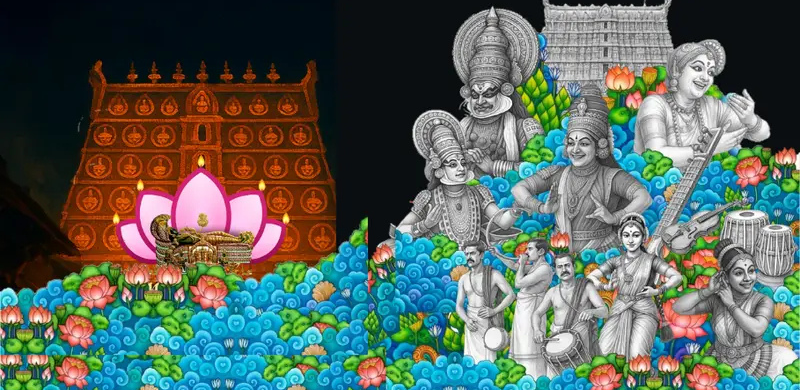
Sree Padmanabhaswamy Temple:
General Darshan Timings (Subject to Change):
Morning:
- 3:30 AM - 4:45 AM (Nirmalya Darshanam)
- 6:30 AM - 7:00 AM (Special Darshan)
- 8:30 AM - 10:00 AM (General Darshan)
- 10:30 AM - 11:10 AM (Darshan)
- 11:45 AM - 12:00 PM (Midday/Afternoon Aarti)
Evening:
- 5:00 PM - 6:15 PM (Evening Darshan)
- 6:45 PM - 7:20 PM (Evening Aarti)
Best Time to Visit:
Early morning (around 3:30 AM or 6:30 AM) is often recommended to avoid large crowds, especially during peak seasons like Sabarimala season.
Temple Cloak Room Timings | Morning: 03:30 am to 02:00 pm & Evening: 03:30 pm to 09:00 pm
Important notes:
Official Website: For exact, real-time timings, especially during festivals, see the official Sree Padmanabhaswamy Temple website, spst.in.
Restrictions:
Photography, filming, and mobile phones are normally prohibited inside.
Dress Code for Men ;
Wear a dhoti and an angavastram (optional) and avoid covering your head.
Dress code for women ;
Women can dress in Sarees, wrap a Dhotie above their pant, Pavadas with a blouse, or other acceptable attire based on their age group. Salvar outfits and other modern dresses are not permitted. No other sorts of clothing should be worn or brought into the sanctuary.
Dress Code:
A very strict dress code is observed: Men must wear a mundu (dhoti) without a shirt, while ladies must wear a saree, set-mundu, or skirt and blouse; shorts are not permitted.
Maha Kshetram's (Great Temple) characteristics
The 10 qualities listed below elevate a temple to the status of a Mahakshetram (Great Temple) in addition to the recognised spiritual and structural elements. These include antiquity, the existence of records, historical significance, woodland origin, proximity to an ocean, elevation, royal ties, mention in ancient literature, architectural majesty, and festival grandeur. All of these qualities are met by the Sree Padmanabhaswamy Temple.
Idol of Ananthasayanam
When twelve Salagramas stones are worshipped collectively, they are said to acquire the power of a Mahakshetram (Great Temple). Twelve thousand and eight (12008) Salagramas that were gathered from the Gandaki River bed in Nepal make up the interior of the Katusarkara Idol of Sree Padmanabha Swamy. Sree Maha Vishnu is represented with salagramas. This temple acquires the majesty and holiness of a thousand magnificent temples.
Mandapam Ottakkal
One notable aspect of the Sree Padmanabhaswamy Temple is the Ottakkal Mandapam (single stone platform). The Mandapam stands in front of Lord Sree Padmanabhaswamy's sanctum sanctorum. One twenty-foot-square, two-and-a-half-foot-thick granite slab was used to construct this building. In this Mandapam, the Abhishekams to Sree Padmanabhaswamy are performed. Gold covers its granite pillars.
The existence of Shiva
The holiness of a Maha Kshetram devoted to Vishnu is enhanced by the presence of Shiva within the Sreekovil. The images of Lord Shiva are displayed throughout the Temple. This temple, like many others in Malayala Nadu, was spared of the cult conflicts that frequently tarnished the image of orthodox religion in several parts of India. The existence of Siva is sufficient evidence.
Mandapam Abhisravana
This building is located outside the Cherruchuttu, which houses the sanctum sanctorum, but in front of the Ottakkal Mandapam. Here, special poojas associated with temple festivals are performed. This Mandapam is used by devotees for prayer and meditation.
Mandapam Kulasekhara
TIt is an amazing piece of stone architecture. It is also referred to as Sapthaswara Mandapam and Aayiramkaal Mandapam. There are 28 balustrades of pillars supporting it. When tapped, the pillars on each of the four corners can make musical notes. Beautifully carved figures in half and full relief adorn the pillars.
The staff of the Golden Flag (Dwaja Stambham)
Anizham Tirunal erected an eighty-foot-tall pole close to the eastern corridor. This size of teak wood was transported to the Temple from the neighbouring forest. The wood should not come into contact with the earth during transit, according to Sastras. After that, gold foil was used to completely cover the teak pole. Garuda Swamy is depicted kneeling at the top of the flagpole.
Nine Points of Entry
The Temple's nine entrances correspond to the human body's nine orifices.
Gopuram
On the eastern entrance of the temple is a seven-story gopuram. It is a magnificent example of Dravidian-style South Indian architecture. Its height is around thirty-five meters.There are seven golden domes at the top that appear to be references to the seven worlds.The first floor of the gopuram depicts the ten incarnations of Lord Vishnu. The remaining three entrances are double-story Padippuras designed in the Keralan style. There are restrictions on access to the Gopuram's top levels.
The Corridor of Sreebalippura
There is an amazing Sreebalippura at the Temple. The principal temples are surrounded by this gorgeous rectangular stone hallway, which is where the Vahanams are carried during Sreebali (procession). According to records, 4000 stone craftsmen, 6000 labourers, and 100 elephants laboured every day for six months to complete the Sreebalippura's construction. There are 365 and a quarter pillars supporting Sreebalippura. Every single pillar is a monolith. The work was overseen by Ananthapadmanabha Moothassari, a great craftsman.
Theerthams (resources of sacred water)
Numerous precious water resources are located within the Temple, even at distant locations. The primary one, Padmatheertham, is situated on the Temple's eastern side. One of Thiruvananthapuram's oldest bodies of water is Padmatheertham.
Bells
The Temple is decorated with a large number of bells. A metal banian leaf is typically affixed to the bell's tongue near the tip
Variety of Mandapams
The variety of Mandapams (platforms) in this temple is another characteristic. The Temple has eleven mandapams, whereas the Padmatheertham pond has eight.
Paintings on Murals
Murals adorn the exterior walls of Lord Padmanabha and Sree Krishna's sanctum sanctorum. Chalayil Kalahasti, a Brahmin artist, painted the Ananthasayanam on the rear of the shrine, which is regarded as the biggest of Kerala's temple paintings. It is eighteen feet long.
Temple of Thiruvambadi Sree Krishnaswamy
The Thiruvambadi Sree Krishna Swamy Temple enjoys the status of a distinct temple with its own flagstaff, sacred stones, and rites and rituals, while being located inside the main temple walls. It is really uncommon.
Sree Padmanabhaswamy Temple
The Temple of Sree Padmanabhaswamy's history is lost in antiquity. The actual date and identity of the original Sree Padmanabhaswamy idol's consecration cannot be ascertained from any trustworthy historical records or other sources. The Puranas and Epics also make references to the Temple. According to Srimad Bhagavatha, Balarama came to this temple, had a Padmatheertham bath, and made a number of sacrifices.
Ten poems praising Lord Padmanabha were written by Nammalwar, a poet from the ninth century and one of the twelve Vaishnavite saints of the Alvar tradition.According to certain renowned academics, authors, and historians, such as the late Dr. L.A. Ravi Varma of Travancore, this temple was founded on the first day of Kali Yuga, which is more than 5000 years ago.
Over the ages, the Temple's tales have been passed down. One such tradition, found in the Temple's ancient palm leaf records and the renowned grantha "Ananthasayana Mahatmya," states that it was dedicated by Divakara Muni, a Tulu Brahmin recluse. The idol was reinstalled during the 950th year of Kali Yuga. The Abhisravana Mandapam was constructed by King Kotha Marthandan during the 960th Kali year.
The Ananthasayana Mahatmya tells the following story
A renowned Vishnu Bhaktha was Divakara Muni. He did deep tapas at "Aanarthadesa." Maha Vishnu once showed up as a charming youngster in front of the sage. The sage was drawn to the endearing child. He asked the God-child to remain with him. His stay was conditioned by the child. He should therefore be treated with respect by the Sanyasi. If he didn't, he would immediately disappear.
The child stayed with him after this was acknowledged. He was well taken care of by the hermit, who also put up with his juvenile antics. One day, while the sanyasi was in deep meditation during his prayers, the chills took the "salagram" that the sanyasi was using for devotion, put it in his mouth, and caused so much trouble that Divakara Mini became extremely irate and could take it no more.
The child was then reprimanded by him. As per the previous agreement, the child instantly fled and vanished from the area. "If you wish to see me again, you will find me again in Ananthankaadu," he added as he was leaving. Only then did Divakara Muni recognise the identity of his former little visitor. For many days, the hermit followed what he thought was the child's path—forgoing food, rest, and sleep—because he was overcome with unbearable anguish.
When he finally arrived at a forested spot close to the seaside, he saw the boy vanish inside a massive "Ilappa" tree. The tree instantly collapsed to the ground and took on the shape of Sree Maha Vishnu. The holy form's feet were at "Trippapur," which is five miles north, and its head was at "Thiruvallam," which is roughly three miles from East Fort and the location of the Temple of Sree Padmanabha Swamy. The Sanyasi, overwhelmed by the magnitude and majesty of the holy figure that appeared before him, asked the Lord to shrink Himself so that he might see Him.
The Lord's image then shrank to three times the length of the Sanyasy's yoga dand. His prayers had been answered. He offered a raw mango in a coconut shell right away, and he continues to do so. The Lord mandated that Tulu Brahmins perform poojas for Him. The Tulu region is still represented by half of the poojaris (priests) in this temple. Another widely acknowledged account of the temple's beginnings links it to the renowned Namboothiri sanyasi Vilvamangalathu Swamiyar, whose name is associated with the histories of multiple temples in Southern India. Another Vishnu bhaktha was this Swamiyar.
The legend is nearly the same as the one about Divakara Muni mentioned earlier. It is told that the sage at Ananthankaadu had nothing valuable to offer Sree Maha Vishnu when he appeared to him in the Ananthasayana rupa (reclining on Anantha). He picked a few unripe mangoes from a nearby mango tree, put them in a coconut shell, and humbly gave it to the Lord as "nivedyam." Salted mango is still a popular option today. The original coconut shell has been covered in gold.
Additionally, a Namboothiri Brahmin sanyasi, known as Pushpanjaly Swamiyar, who has been expressly commissioned for this purpose, has been doing the morning "pushpanjali" in the Temple for several centuries. The idea that Vilvamangalathu Swamiyar founded this temple has some substance and credibility because of these customs and the Pushpanjali Swamiyar's prominent position in the "Ettara Yogam," a committee that was once the Temple's governing body but has since evolved into a ceremonial and advisory panel.
On the other hand, the existence of several Tulu Brahmins supports the legend of the Divakara Muni. The Namboothiri Brahmins hold a prominent position in the temple's rites and celebrations in addition to being portrayed in the "Yogam." This community's Tharananalloor family has traditionally produced the Tantries, or high priests. The little Sree Krishna Swamy Temple is thought to have been constructed over Vilvamangalathu Swamiyar's Samadhi. It is situated next to the Western Swamiyar Madham, which is home to one of the two Pushpanjali Swamiyars of the Temple.
According to some historians and scholars, Sree Krishna Swamy's Thiruvambadi shrine predates Sree Padmanabhaswamy's. Legend has it that the idol of Lord Sree Padmanabhaswamy was installed before the Sree Narasimhaswamy and Sree Sastha shrines were built. Sree Balarama visited "Syanandoorapuram" or "Ananthasayam" (Thiruvananthapuram) on His trip, according to the "Bhagavatha Purana" (canto 10, chapter 79). Likewise, "Syanandoorapura" is mentioned in the "Brahmanda Purana."
These allusions demonstrate how old this temple is and how it has been revered for generations as a significant location for Sree Maha Vishnu. The eminent Vaishnavite saint Nammalvar's works praising this city's Sree Maha Vishnu unmistakably demonstrate that this temple was in existence throughout the ninth century. The Temple was rebuilt in 1050 A.D. (225 ME), and the monarch at the time reorganised the administration. The following significant historical occurrences take place between 1335 and 1384 A.D., when Veera Marthanda Varma, a strong and astute monarch, governed Venad. Over time, he achieved total control over the Temple's administration and operations
A.Records show that the Alpasi Utsavam, a ten-day festival held in October and November, was held in the Temple in 1375 A.D. The following lists some of the significant Temple-related events that occurred between this ruler's death and 1729 A.D. The deity of Sree Padmanabhaswamy was transported to a "Balalaya" between 1459 and 1460 A.D. in order to rebuild the sanctum sanctorum's roof. The deity was reinstalled in 1461 A.D., and a single granite stone slab called an Ottakkal Mandapam was erected next to the sanctum sanctorum.
The Gopuram (pagoda) over the main eastern entrance had its foundation laid in 1566 A.D. The Temple was nearly completely destroyed in a significant fire incident in 1686 A.D. Only in 1724 did work on the Temple's reconstruction begin. Propitiatory ceremonies were held in 1728 A.D. in response to the devastating fire of 1686. The legendary monarch Marthanda Varma ascended to the throne of Travancore in 1729.
He started the process of remodelling the Temple. Before the sanctum sanctorum was renovated and rebuilt in 1730, the idol was once more relocated to "Balalaya." The project took two years to finish. The modern idol took the place of the ancient wooden one. It is composed of Katusarkarayogam, a very complex amalgam that comprises 12008 Salagrams.
The majority of what is currently visible within the temple's walls was built. The construction of the Sreebalippura (the oblong corridor) was completed over the course of six months by 4000 sculptors, 6000 workers, and 100 elephants. On rainy days, the Deities are shielded by this wonderful rectangular corridor made of solid stones.
During this time, the gopuram, for which the foundation had been put in 1566, was constructed. In a same vein, the flagstaff in front of the main shrine was built during this period. For this reason, teak wood of the necessary size was harvested from the forest and delivered to the Temple so that no portion of the wood came into contact with the earth. After that, gold sheets were used to completely cover the pole. During this great ruler's reign, the Padmatheertham, the Temple tank, was renovated, including the flight steps, and finished in the current configuration.